The concept of ‘Waqf’ is rooted in Islamic laws and traditions. It refers to an endowment made by a Muslim for charitable or religious purposes, such as building mosques, schools, hospitals or other public institutions. Another defining feature of Waqf is that its inalienable which means it cannot be sold, gifted, inherited or encumbered. Therefore, once a property is divested from the waqif (the creator of a waqf) is the ‘waqf property’ it can not be sold, gifted.
The Waqf (Amendment) Bill, 2025 aims to update the Waqf Act, 1995 to fix issues in the management of Waqf properties. The proposed changes focus on the following aspects:-
The Mussalman Wakf (Repeal) Bill- 2025 seeks to remove the outdated Mussalman Wakf Act-1923, which is no longer effective. The Amendment Bill will be effective which are as under:-
Major Issues
(a) Illegal occupation of Waqf land.
(b) Mismanagement and ownership disputes.
(c) Delays in property registration and surveys.
(d) Large-scale litigation cases and complaints to the Ministry.
(e) Decisions by Waqf Tribunals cannot be challenged in higher courts.
(f) This reduces transparency and accountability in Waqf management.
(g) Incomplete survey of Waqf Properties: States like Gujarat and Uttarakhand surveys have not even started. In Uttar Pradesh a survey ordered in 2014 is still pending.
(h) Misuse of Waqf Laws: Some State Waqf Boards have misused their powers, leading to community tensions. Teh Waqf Act applies only to one religion, while no similar law exists for others. In this connection, a PIL (Public Interest Litigation) has been filed in the Delhi High Court, questioning whether the Waqf Act is constitutional. The Delhi High Court asked the Central Government to respond to this issue.
| Name – Wakf Act 1995 | Unified Waqf Management, Empowerment, Efficiency, and Development Act-2025 |
| Waqf could be formed by declaration, user or endowment (waqf-alal-aulad) | (a) Removes Waqf by user and allows formation only through declaration or endowment (b) Donors must be practicing Muslims for at least five years and must own the property. (c) Waqf-alal-aulad cannot deny inheritance rights to female heirs. |
| No Clear Provision | Any government property identified as Waqf will cease to be waqf. Ownership disputes will be resolved by the collector, who will submit a report to the state government. |
| Required State level Tribunals for disputes led by Judge | A current or former District Court judge will be a chairman |
| A state officer (Additional District Magistrate rank) | A current or former joint secretary to the state government & there is no need to be a Muslim law expert. |
| State Government can audit Waqf account at any time | The Bill will be audited by the CAG (Comptroller and Auditor General) or a designated officer. |
| Separate Waqf Boards for Sunni and Shia sects | Separate Waqf boards allowed for Bohra and Agakhani sects, along with Shia and Sunni sects. |
The Waqf boards were constituted in 1913, during the British rule. The first legislation to regulate waqfs was enacted in 1923. It was named as “The Mussalman Waqf Act 1923”. Earlier in India a Ministry of Minority Affairs was set up in 1964, the Central Waqf Council comes under the administrative control of Ministry of Minority Affairs. As per the provision given in the Waqf Boards and the due administrative of Auqaf. This act was later repealed. Central Waqf Council is an Indian Statutory body operated by the Government of India under the Waqf Act, a subsection of Waqf Act 1995. The Existing Waqf Act was passed in 1995.
Central Waqf Council
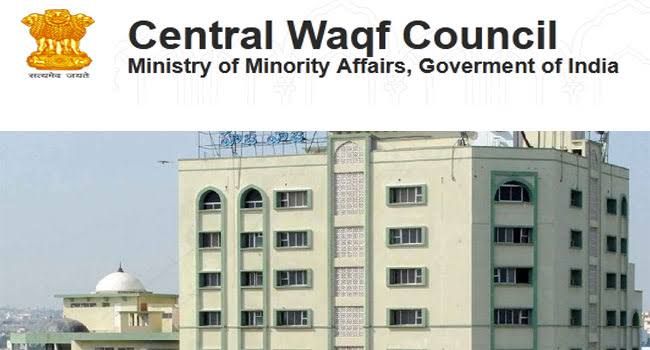
Presently there are thirty Waqf Boards across the country in twenty-eight states and Union Territories. States such as Goa, Arunachal Pradesh, Mizoram, Nagaland and Sikkin and the Union Territory Daman and Diu have no Waqf Board at present. The Waqf Act 1995 is not applicable to Jammu & Kashmir. The State Waqf Boards are established by the State Governments. These work towards management, regulation and protect the Waqf properties by constituting District Waqf Jammu & Kashmir. Justice Shasvat Kumar, who headed the Shashvat Committee has prepared a status report on Muslims in India in 2011 and finding of this report was that Nationwide, Waqf properties constitute an land bank worth Rs 1.2 Lakh crores and found that there was a severe shortage of senior government officers who are Muslims to manage Waqf Affairs. A separate cadre would mean officers who are not only permanent but also qualified enough.
The Haryana Waqf Board registered an all time high income of Rs 17.03 crores during 2010-11, which is Rs 3.33 crore higher than the previous year. During 2010-11, The Board spent Rs 3.32 crore on various educational and welfare activities. The Board had earmarked Rs 6.47 crore in the budget for 2011-12 to meet the main objectives of waqfs and various educational and welfare activities. The Waqf Boards shall be body property. In the Case that more than fifteen per cent of the total number waqf property is Shia waqf, or the income thereof is more that fifteen per cent, the Act envisages a separate Shia Waqf Board.
The Waqf Amendment Bill 2024 has been passed in both houses of the Indian Parliament, sparking strong reactions from the All India Majlis-e-Ittehad-ul-Muslimeen (AIMIM) leader Asaduddin Owaisi. In response to the bill, Owaisi has approached the Supreme Court, preparing to fight the matter legally. AIMIM chief Asaduddin Owaisi strongly opposed the Waqf (Amendment) Bill in the Lok Sabha, terming it an “attack on the faith and religious practices of Muslims.” In a dramatic protest, Owaisi symbolically ‘tore’ the bill, likening his act to Mahatma Gandhi’s defiance of unjust laws. https://youtu.be/HP6nHS92C5w
This post was published on April 5, 2025 11:02 pm
The People’s Republic of China is the world’s most populous country and the second-largest economy…
Saudi Arabia occupies a pivotal position at the crossroads of Europe, Asia and Africa. it…
North Korea, officially known as the Democratic People's Republic of Korea (DPRK). Situated in the…
This website uses cookies.
Read More

View Comments
Good article
Thanks dear